Books Overview
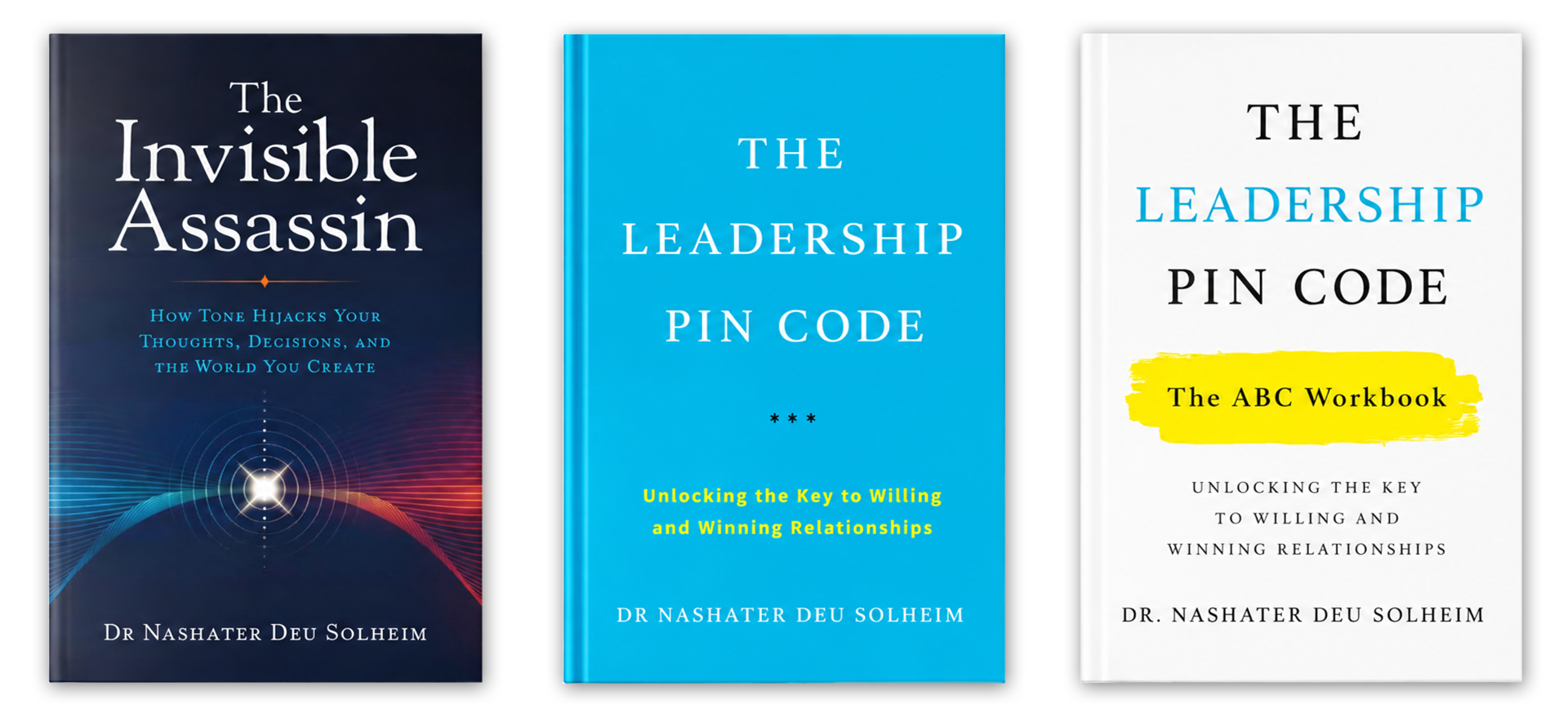
The books behind this work shape the advisory, team coaching and speaking. They focus on what shapes human behaviour, trust, influence, judgment and the results people create together under real pressure.
Books
-
How tone hijacks your thoughts, decisions, and the world you create.
The most powerful influence in any room is often the one nobody notices: tone.
Before you have time to weigh the words, tone is already shaping whether an interaction feels safe, believable, threatening, or true. Tone can make a stranger seem trustworthy, a leader sound convincing, a friend’s voice bring relief, or a politician’s speech stir loyalty or fear.
-
The Leadership PIN Code introduced a practical framework for influence, negotiation and shaping outcomes between people. It gave leaders tools. But it also pointed to something deeper:
People do not respond to words alone.
-
The ABC Workbook is the hands-on companion to The Leadership PIN Code. Where the book gives you the framework, the workbook makes it yours.

Frequently asked questions
-
Nashater Deu Solheim is a clinical psychologist, Harvard-trained negotiator and executive advisor based in Stavanger, Norway. She specialises in forensic psychology, neuropsychology and behavioural leadership, and has worked with senior leaders across energy, technology, finance, healthcare and elite sport for over 25 years. She is the author of The Leadership PIN Code, endorsed by Forbes and recommended by the Harvard Business Review, and gave a TEDx talk with over 1 million views entitled “What Working with Psychopaths Taught Me About Leadership”
-
Psychopaths are highly skilled at reading social signals, projecting confidence, managing perception and influencing others without reciprocity. Studying these dynamics reveals what most leadership advice leaves out: the mechanics of how people actually influence each other, where trust breaks down, and how behaviour spreads through a system. Those insights apply directly to how leaders manage teams, set culture and handle power responsibly.
-
Her approach draws on three distinct professional disciplines: clinical psychology, neuropsychology and forensic psychology, combined with direct field experience across military environments, elite sport and high-stakes organisational settings. Unlike most executive coaches, who come from business or HR backgrounds, Nashater has also been an executive leader herself — she knows the pressures, the decisions and the dynamics from the inside, not just as an observer.
That combination gives her an unusually precise lens on what drives results between people: grounded in how behaviour actually forms and changes, under pressure, in extremis, across very different contexts — and tested in the real environments where leadership is most demanding.
-
Dysfunctional beliefs are the assumptions leaders hold about how influence, authority and communication work, assumptions that feel reasonable but consistently undermine results. Common examples: that authority alone commands compliance; that projecting confidence substitutes for preparation; that good intentions produce good outcomes; that intelligence is sufficient for persuasion. The problem is not that these beliefs are irrational; they are widely shared. The problem is that they disconnect leaders from the signals they send and the responses they elicit. Identifying and challenging these beliefs is often where the most significant leadership change begins.